Dedicated Circuit Required: Which Appliances Need Their Own Breaker?
Washing machine, cooker, tumble dryer and fixed-location appliances from 2600 W: the AREI requires a dedicated circuit. With references and RCD guidance.
 AuthorStephan Behm
Which appliances need their own circuit?
In a dwelling, two groups of appliances get their own circuit: every appliance with a fixed location rated at 2600 W or more and, regardless of power, the washing machine, dishwasher, tumble dryer, electric cooker, electric hob and electric oven. "Fixed location" also covers an appliance you move now and then, for example a freestanding cooker when cleaning; an electric radiator on wheels is a mobile appliance and falls outside the rule (AREI Book 1, part 2, definitions). Fixed electric heating is supplied by one or more separate circuits. That is the rule in Book 1 of the AREI/RGIE, Belgium's general regulations for electrical installations, subsection 5.2.1.2.
| Appliance | Rule | Reference |
|---|---|---|
| Washing machine, dishwasher, tumble dryer | each on its own dedicated circuit | 5.2.1.2 |
| Electric cooker (hob and oven in one appliance) | one dedicated circuit | 5.2.1.2 |
| Separate hob and built-in oven | each on its own dedicated circuit | 5.2.1.2 |
| Fixed electric heating | one or more separate circuits | 5.2.1.2 |
| Water heater, heat pump, sauna and others | own circuit from 2600 W at a fixed location | 5.2.1.2 |
| EV charger | one separate circuit per connection point; connecting via a socket is prohibited | 7.22.3 |
The rule sets the structure: one appliance, one circuit. You then choose breaker and cross-section for the appliance, based on its nameplate, the supply system, installation method, grouping, cable length, voltage drop and the manufacturer's instructions. The maximum per cross-section is in table 4.11 of subsection 4.4.1.4; the method is explained in cable cross-section and breaker.
"Its own breaker" is therefore the rule of thumb for the large household appliances, not a literal requirement in every case. For an EV charger, the overcurrent protection may sit in the charging equipment itself rather than in the distribution board (7.22.3). For fixed electric heating, several appliances may share a circuit, because the AREI allows "one or more" circuits (5.2.1.2).
Does this also apply to an existing installation?
The rule applies to new installations and to new or modified parts. In existing parts of an old domestic installation (started before 1 October 1981) and of an installation inspected under the old AREI, a circuit that is not dedicated to the appliance may stay in service (AREI Book 1, part 8, sections 8.2.1 and 8.2.2, point 5). A washing machine on the socket circuit is therefore not automatically a defect in such an installation. If you add a new circuit or replace the appliance with a more powerful one, subsection 5.2.1.2 applies.
What a dedicated circuit gives you
- No overload from neighbours: a powerful appliance often runs close to its rated current for long periods. On its own circuit it shares that load with nothing else.
- Availability: if the breaker trips, only this appliance goes off, not half the kitchen.
- Matched wiring: cross-section and protection fit exactly one appliance instead of a mix.
Apply the rule appliance by appliance
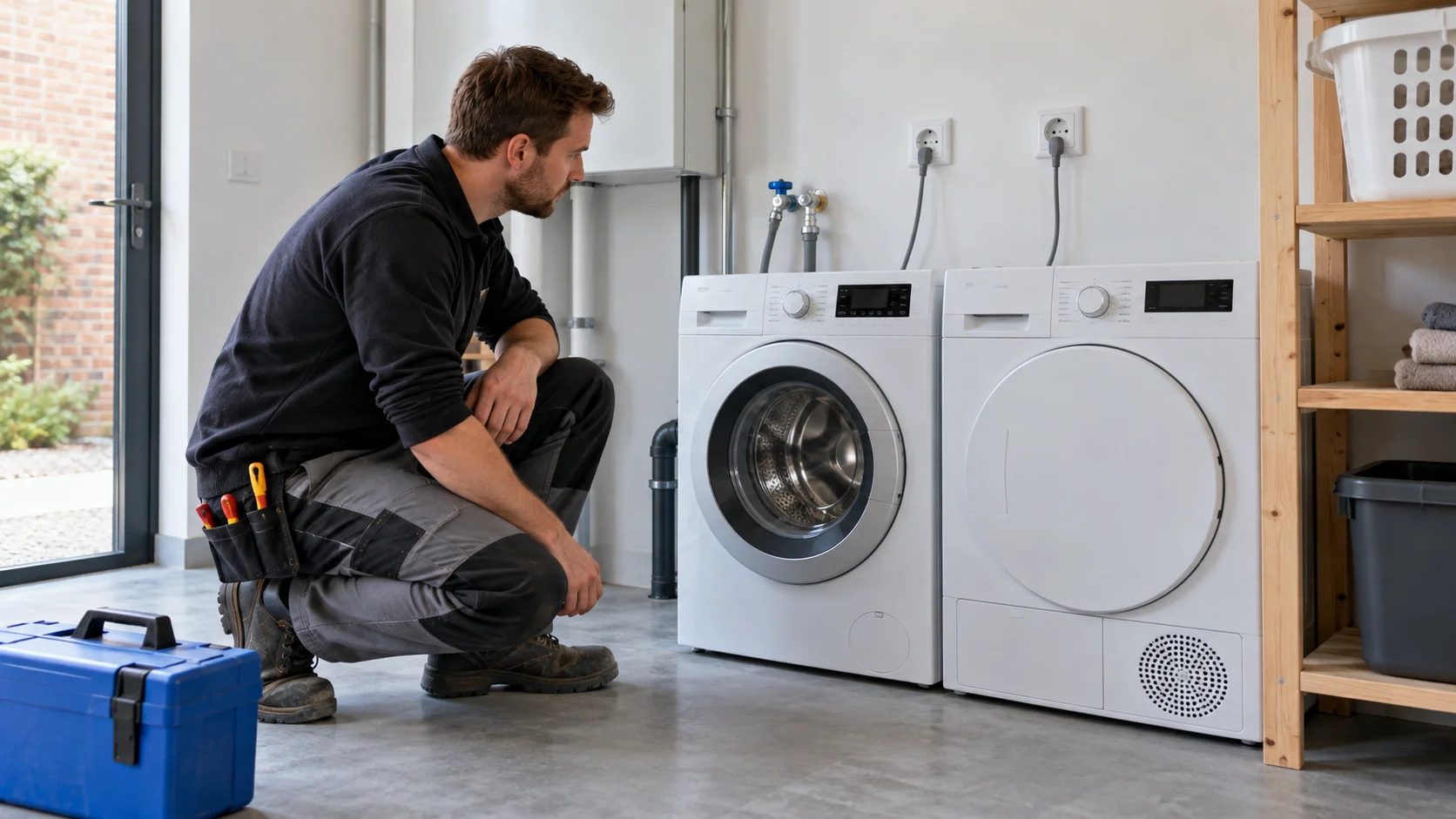
Start with the nameplate and the installation manual. Record the rated power, single- or three-phase connection, the permitted connection method and any protection requirements from the manufacturer. A combined cooker (hob and oven in one appliance) is one circuit; a separate hob and a built-in oven each get their own dedicated circuit. A heat pump may need separate feeds for the outdoor unit, indoor unit and backup heater. Plan those cases one by one.
For a heat pump or water heater below 2600 W, the AREI does not explicitly prescribe a separate circuit. Follow at least the 2600 W rule; in practice you almost always choose a dedicated circuit.
On the single-line diagram, each appliance circuit gets its own reference with protective device, cable data and end appliance. The situation plan shows the same reference at the appliance location. If the appliance is later replaced by a more powerful one, you recheck the design.
Laundry and utility room
The washing machine and tumble dryer each get their own circuit, and so does a water heater of 2600 W or more. Also plan an ordinary socket circuit for the iron and small appliances, so they are not plugged into the appliance sockets. How many sockets such a circuit may carry is covered in how many sockets per circuit?.
Which RCD goes in front of which appliance circuit?
A dedicated circuit does not yet say which RCD protects it. Subsection 4.2.4.3 b settles that: sockets, lighting, bathrooms and also the washing machine, tumble dryer and dishwasher go behind an RCD with high or very high sensitivity (30 mA at most), with at most eight final circuits per RCD. Fixed appliances, by contrast, may be connected to an additional RCD at the origin of the installation.
| Appliance | RCD | Reference |
|---|---|---|
| Washing machine, tumble dryer, dishwasher | high or very high sensitivity (30 mA at most), like sockets and lighting | 4.2.4.3 b |
| Cooker, hob, oven, fixed electric heating | may go on an additional RCD at the origin of the installation (for example 300 mA) | 4.2.4.3 b |
| Resistance heating embedded in walls (above 25 V AC) | its own RCD of 100 mA at most | 4.2.4.3 b |
| EV charger | each circuit individually 30 mA at most, with protection against DC fault currents | 7.22.4.1 b |
The "may" for cooker and heating is a permission, not a ban on 30 mA. More on the split in do I need a 30 mA RCD for every socket?.
How PlanElec checks appliance circuits
For large appliances from the device catalogue – including cooker, oven, washing machine, tumble dryer, dishwasher and EV charger – the AREI/RGIE self-check flags an error as soon as the appliance shares its circuit with other loads. If no circuit breaker is assigned yet, it shows the missing input. The catalogue also always marks water heater, heat pump and sauna as appliances with their own circuit, even below 2600 W; that is stricter than the AREI. You read the 2600 W threshold for other appliances from the nameplate. The inspection of the installation is carried out by the recognised inspection body. The rules covered are listed in what the self-check verifies.
Frequently asked questions
Does a fridge or freezer need its own circuit?
No. A fridge is an appliance with a fixed location, but the obligation only applies from 2600 W rated power (5.2.1.2). Ordinary fridges and freezers are far below that.
Can a washing machine and a tumble dryer share a circuit?
No. The AREI supplies the washing machine, dishwasher and tumble dryer each separately by a dedicated circuit (5.2.1.2). Two appliances on one circuit do not meet that.
Does an induction hob always need its own circuit?
Yes, regardless of its power. The electric hob is named explicitly in the list in 5.2.1.2. A separate built-in oven also gets its own circuit; only a cooker combining hob and oven in one appliance shares a single circuit.
Does an air conditioner need its own circuit?
Only from 2600 W rated power for an appliance with a fixed location (5.2.1.2). Below that, the manufacturer's installation manual says what is needed.
Do I have to change my old installation if the washing machine is on the socket circuit?
Not automatically. In existing parts of old installations, or of installations inspected under the old AREI, such a circuit may stay in service (sections 8.2.1 and 8.2.2, point 5). For a new or modified circuit, or a more powerful appliance, subsection 5.2.1.2 applies.
Which RCD goes with the washing machine and which with the cooker?
The washing machine goes behind an RCD of 30 mA at most; the cooker may go on an additional RCD at the origin of the installation (4.2.4.3 b). See the table above.
Related articles
- Which cable cross-section for which circuit breaker?
- Do I need a 30 mA RCD for every socket?
- How many sockets per circuit?
- Electrical inspection in Belgium
- Showing a heat pump on the single-line diagram
Official source: AREI Book 1, version 06 (until 31 October 2026) and version 07 (from 1 November 2026; these passages are unchanged in substance, only the sealing of the RCD is dropped in 4.2.4.3 b): part 2 (definitions), subsections 4.2.4.3, 4.4.1.4 and 5.2.1.2, sections 7.22.3 and 7.22.4 and part 8, sections 8.2.1 and 8.2.2.
Plan your appliance circuits in PlanElec and check them yourself →